
 Content Writer: Janice Chew • Friday, 26/05/2026 - 16:25:01 - PM
Sustainability in the gaming industry is evolving far beyond marketing slogans and symbolic green initiatives. Today, leading integrated resort operators are embedding environmental and social responsibility directly into the way they run their businesses every day. That is precisely the direction Melco Resorts & Entertainment continues to pursue through its latest sustainability strategy and newly released 2025 sustainability report.
The report, titled “RISE to Go Above & Beyond”, outlines Melco’s sustainability progress across its global operations in Macau, Manila and the Cyprus, while highlighting how sustainability is increasingly becoming integrated into operational decision-making rather than existing as a separate corporate initiative.
Sustainability Through “Double Materiality”
One of the most notable aspects of the report is Melco’s adoption of a “double materiality” approach — a framework increasingly used by global corporations to assess sustainability issues based on:
- Their impact on the business itself
- Their impact on the wider environment and society
This approach evaluates sustainability not just from a compliance perspective, but also from how environmental and social issues affect the company’s long-term enterprise value and global value chain.
Melco Chairman and CEO Lawrence Ho Yau Lung explained the company’s long-term direction clearly:
“Since launching our RISE sustainability strategy in 2019, our ambition has been clear: to integrate sustainability into how Melco operates, not as a parallel agenda, but as part of the business itself.”
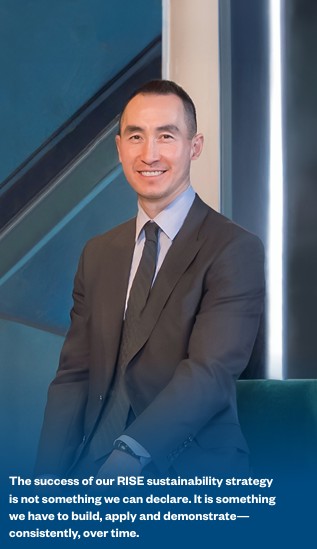
That statement reflects a broader shift happening across the integrated resort industry, where ESG is increasingly becoming operational strategy rather than merely a reporting exercise.
Major Environmental Progress Across Operations
The report highlights several substantial operational achievements achieved during 2025.
Energy and Water Savings
Melco reported:
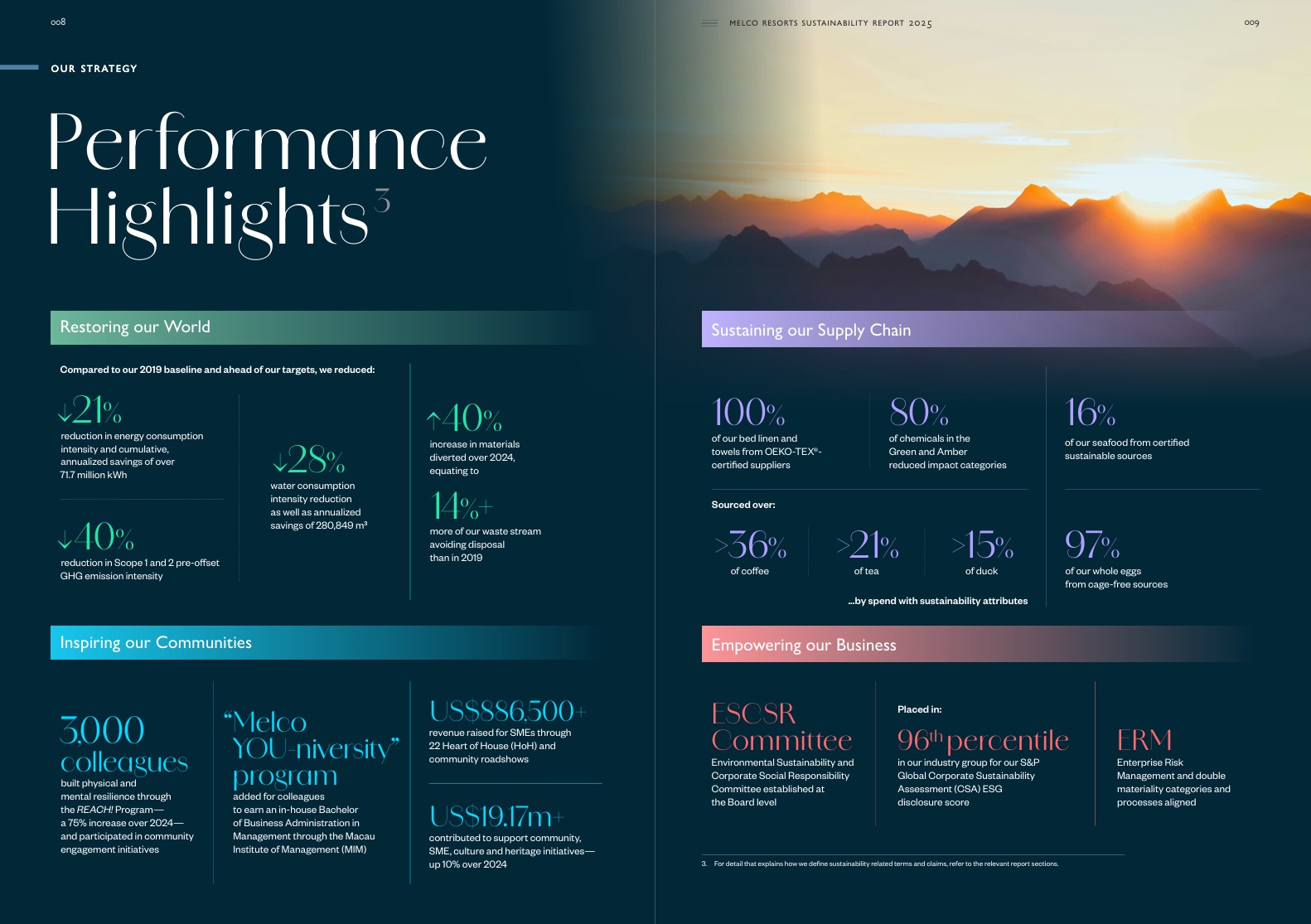
- Annualised energy savings exceeding 71.7 million kWh
- Annualised water savings exceeding 290,000 cubic metres
According to the company, the electricity savings are equivalent to powering more than 10,000 homes annually, while the water savings equal approximately 116 Olympic-sized swimming pools.
The company’s renewable energy initiatives also continue expanding, with solar panel systems across its properties generating close to 10,000 megawatt hours annually, enough to power approximately 1,900 households each year.
Green Mobility and Waste Reduction
Melco is also steadily transitioning toward greener transportation infrastructure.
The company revealed that:
- 65% of its total fleet now consists of electric and hybrid vehicles
- 154 EV charging stations have been installed across its properties globally
Waste management efforts have similarly accelerated.
Since 2019:
- Waste diversion rates through recycling and composting increased from 4% to 18%
- More than 1,400 tonnes of food waste have been composted using onsite composting systems
In 2025 alone, Melco recycled over 1.7 tonnes of playing cards across Macau, Manila and Cyprus — a symbolic but meaningful example of how sustainability is being applied even to routine gaming operations.
For casino operators, playing cards are replaced frequently for security and compliance purposes. Turning these consumables into recyclable material instead of landfill waste reflects a broader operational sustainability mindset.
AI-Powered Food Waste Reduction
Interestingly, the report also highlights how technology is becoming part of Melco’s sustainability framework.
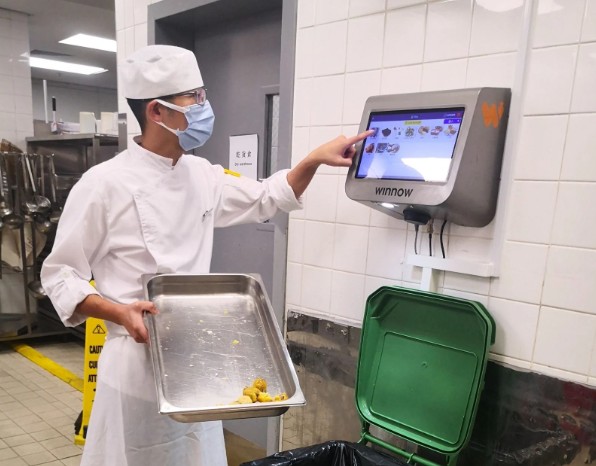
The company deployed Winnow Solutions artificial intelligence-powered systems in employee dining rooms to monitor food waste patterns. The initiative helped reduce average plate waste per cover across Macau and Manila properties by 4% year-on-year during 2025.
This demonstrates how AI and operational analytics are increasingly being used in hospitality environments to improve both efficiency and sustainability simultaneously.
Sustainability Also Means People
Beyond environmental goals, Melco’s report places significant emphasis on employee wellbeing and community engagement.
Highlights include:
- 4,100 employees participating in 486 volunteer activities worldwide
- More than 3,000 employees joining “REACH! Sports” wellness initiatives
- Over 700 employees supported through mental wellbeing seminars and counselling programs
The company also delivered:
- More than 763,000 learning hours
- Across over 1,400 training courses
- Resulting in over 783,000 course enrolments
These figures underline how workforce development and employee wellbeing are becoming core pillars of modern ESG strategies within the hospitality and gaming sectors.
Strengthening Local Communities
Melco also disclosed contributions exceeding US$19.17 million toward:
- Local community support
- SME development
- Cultural preservation initiatives
- Heritage conservation efforts
This community-focused investment is increasingly important as integrated resort operators work to demonstrate broader economic and social value beyond gaming revenue generation alone.
ESG Recognition Continues to Grow
In February, Melco Resorts announced its inclusion in the S&P Sustainability Yearbook 2026 — an internationally recognised benchmark evaluating corporate sustainability performance.
Recognition of this nature matters increasingly to:
- Institutional investors
- Global lenders
- Regulators
- International tourism and hospitality partners
For integrated resort operators competing in premium markets like Macau, ESG credentials are gradually becoming part of long-term brand positioning and corporate competitiveness.
The Bigger Industry Shift
What makes Melco’s latest report particularly interesting is not any single sustainability initiative on its own. Rather, it is the broader operational philosophy behind them.
As Lawrence Ho noted:
“What began as commitments and targets has evolved into systems and practices embedded into how our colleagues work on a day-to-day basis.”
That sentence arguably captures the future direction of the global integrated resort industry:
sustainability becoming embedded into operations, culture, procurement, technology and employee behavior — not just annual reports.
For the Asian gaming industry, this may represent the next major evolution beyond post-pandemic recovery:
building integrated resorts that are not only profitable, but increasingly sustainable, resilient and operationally intelligent.